

When I scan a Japanese J.League (J1) round, one thing appears again and again:
The 1X2 prices are often unusually close.
A typical market might look like this:
Home 2.30 — Draw 3.20 — Away 2.80
Compare that with a clear mismatch in the Premier League or La Liga, where you might see a favorite priced at1.25and the outsider pushed beyond10.00.
In Japan, those extreme gaps appear less often.
That is not lazy pricing from bookmakers.
It is the market reflecting one of the defining characteristics of Japanese football:
competitive balance.
Why the J.League Produces Fewer Heavy Favorites
European football has some enormous structural gaps.
The richest clubs can carry deeper squads, more elite individual talent and far greater spending power than teams near the bottom of the table.
That naturally produces aggressive prices.
Japan is different.
The gap between a strong J1 side and an average one is often much smaller than the gap between an elite European club and a relegation candidate.
There are still big clubs and small clubs, of course.
But the league contains fewer matches where one side can be treated as an almost automatic winner.
That changes the entire shape of the 1X2 market.
If bookmakers estimate something close to:
Home: 40%
Draw: 29%
Away: 31%
the resulting prices will naturally sit relatively close together.
The market is not saying:
"We have no idea who will win."
It is saying:
"There isn't much between these teams."
Competitive Balance Compresses the Market
This is the first thing I look at.
Japanese football is full of matches where the stronger side is only slightly stronger.
A better midfield, a deeper bench or stronger recent form may move the probability by a few percentage points.
But that does not automatically justify a 1.50 favorite.
The difference between these two statements is enormous:
"This team is better."
and
"This team is much more likely to win."
Football investors often confuse them.
Bookmakers usually do not.
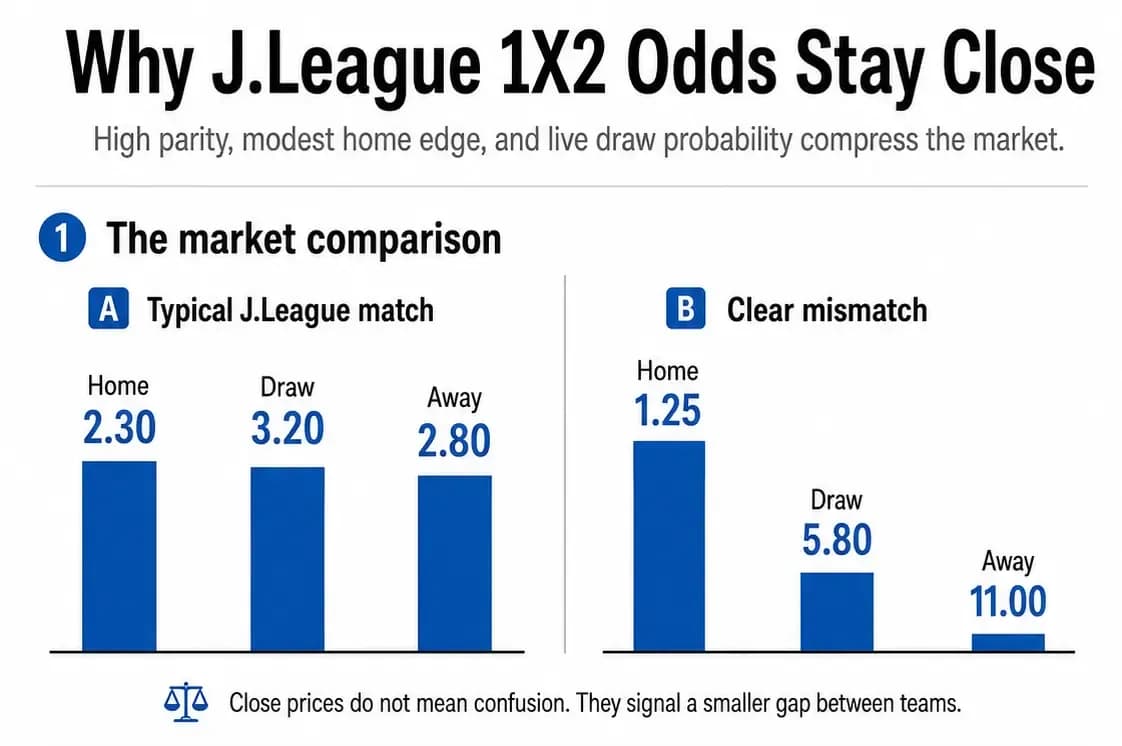
Figure: Tight 1X2 prices usually reflect competitive balance, a modest home edge and a meaningful draw probability—not bookmaker uncertainty.
Home Advantage Matters, But It Does Not Solve Everything
Japanese teams still benefit from playing at home.
But home advantage should not be treated as enough, by itself, to transform an evenly matched fixture into a heavy favorite.
If two teams are close in underlying quality, the home edge may only shift the probabilities slightly.
For example, a neutral matchup might look roughly like:
35% Home — 30% Draw — 35% Away
After accounting for home advantage, it might become:
40% Home — 29% Draw — 31% Away
The home team is now the favorite.
But it is still nowhere near dominant.
That is why you so often see prices such as2.20, 3.20 and 3.00rather than1.45, 4.50 and 7.00.
The Draw Keeps Both Win Prices Honest
Another important part of the equation is the draw.
When teams are reasonably close in quality, neither side controls enough probability to completely squeeze the other two outcomes out of the market.
The draw remains very much alive.
That creates a three-way balance.
Instead of one team absorbing 65% or 70% of the market probability, you often get three outcomes sharing the probability much more evenly.
And once that happens, the 1X2 prices naturally compress.
This is why a J.League fixture can look difficult at first glance.
The favorite may be legitimate.
It just may not be favorite enough.
Check the Asian Handicap Before Falling in Love With 1X2
One of the simplest habits I recommend for Japanese football is this:
Look at the Asian Handicap before making conclusions from the 1X2 market.
If the main line is around:
0.0 (PK)
or
Home -0.25
or
Away -0.25
the market is already telling you the most important thing:
There is no major strength gap.
A tightly packed 1X2 market then makes perfect sense.
I often think of the Asian Handicap as the market's skeleton.
The 1X2 prices are simply another way of expressing the same balance.
Be Careful With Famous Names
This is where the J.League can become interesting.
Recognizable clubs can sometimes attract more confidence from casual money simply because of their name, history or recent success.
That does not automatically mean the price is wrong.
But it does mean I become more careful when a familiar club is suddenly priced much shorter than the underlying matchup appears to justify.
A famous badge is not an edge.
If the market offers1.65but your own assessment says the team wins only 53% of the time, the favorite may actually be the expensive side of the trade.
The question is never:
"Which team is better?"
The question is:
"Is this probability worth this price?"
Tight 1X2 Markets Can Point You Elsewhere
You do not have to force a 1X2 position simply because you are analyzing the match.
Sometimes the best conclusion is:
The win market is correctly balanced.
That is useful information.
You can then move to markets where the tactical matchup may offer a clearer angle:
Asian Handicap
Asian totals
Over/Under goals
Team goals
Corners
A match can be difficult to call from a win-loss perspective while still presenting a strong opinion about tempo, chance creation or territorial pressure.
Professional analysis is not about forcing an answer from every market.
It is about finding the market where your information matters most.
The Real Lesson
Close J.League 1X2 prices are not a sign of bookmaker confusion.
They are usually a sign of respect.
Respect for league parity.
Respect for the draw.
Respect for the fact that many Japanese fixtures contain only small differences between the two teams.
And that creates an important lesson for football investors:
Do not search for "safe winners" in a league built around narrow margins.
Search for mispriced probabilities.
When the market says there is very little between two teams, your job is not simply to choose one.
Your job is to decide whether the market has measured that small difference correctly.